
What Is Education Really For?
written by Sarah Barrett
Recently, my colleague Donovan Gay and I sat down to record the very first episode of our podcast Wonderfully Human, and we began with what may be one of the biggest questions we could ask:
What is education really for?
We spend enormous amounts of time asking how children should learn. We debate curriculum, testing, technology, reading methods, and timetables. Yet before we can answer any of those questions, perhaps we begin with a much simpler question.
When your child is thirty-five years old, what do you hope is true about them?
Picture them many years into adulthood. What do you hope is true about their life? Most parents don't answer with, "I hope they scored well on standardized tests."
Instead, if we really think about it, we will probably say:
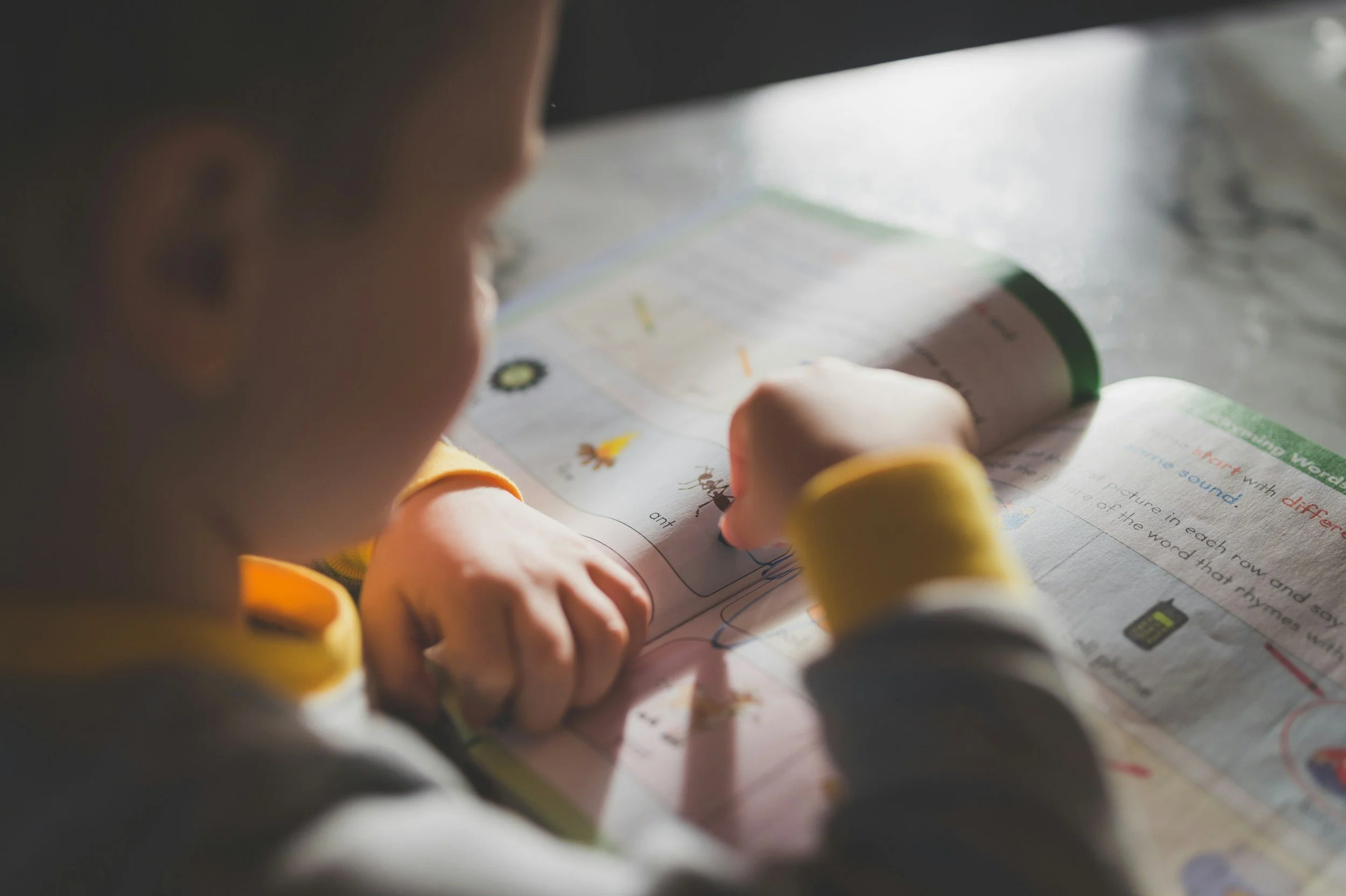
"I hope they're resilient."
“I hope they have empathy.”
"I hope they have meaningful relationships."
"I hope they know what their strengths and gifts are."
"I hope they wake up content about the life they're living."
"I hope they have a deep sense of well-being.”
“I hope they can live each day with authenticity.”
What we long for isn't academic success. In fact, once our children age out of the school years, we see how much life they have to live afterwards, and how the academic pursuits were just a small piece of their life. For the large portion of life that remains, we long for our children to become fully themselves and live a life that is a force for good in this world. Some might call this alignment with their highest self. Yet, did we prepare them for this? What subject in school teaches these things?
Calling Forth What Already Exists
One phrase kept returning to me as we talked during the podcast. Education must call forth the gifts already present within a child. Every child arrives with unique interests, strengths, questions, and ways of seeing the world. Our role is not to manufacture a child’s gifts. They already exist. Our role is to notice them, nurture them, protect them, and create the conditions where they can grow.
Like a gardener, we cannot force a seed to bloom. We can only provide healthy soil, sunlight, water, and time.
Freedom as the Goal
Donovan spoke beautifully about freedom. Not freedom to do whatever we want. But the freedom to think for ourselves and to become who we truly are. To have the capacity to discern truth, to make wise choices, to live according to deeply held values rather than simply following the expectations of culture. Perhaps one of education's greatest gifts is helping young people become free enough to ask meaningful questions and courageous enough to live authentic lives.
Where Do Academics Fit?
Sometimes conversations like this can sound as though we're suggesting that academics aren't important. This cannot be further from the truth, and is often a misconception about Waldorf education.
Children absolutely need to learn to read, write, communicate, think mathematically, understand history, explore science, and engage with the world around them. These are critically necessary for a child to grow to their fullest potential and to contribute their talents to our world.
And on the practical side of things, these skills and thinking exercises help the brain grow to its fullest potential. Everytime we do math or write, we are creating more synapses and literally growing our brains. The stronger and more developed our brain is, the better we will be in the future when it comes to decision making, problem solving, weighing our options, reacting to situations, making judgements, and thinking critically. I saw this desire for optimal brain development for my children grow more urgent in me when they turned 16 and began driving a car!
The way children learn the traditional academic subjects matters just as much as what they learn. After a year of college, my daughter had her first internship over the summer where she was working out in the “real world”. She had held part-time jobs before, but this was the first time working full-time as an adult outside of our local bubble and with people from all over the world. After two weeks at the internship, she called me and said, “I have learned more in two weeks than in an entire year of college!” How powerful for her was learning from experience rather than from the dry textbooks of freshman year. (And how grateful I am that her particular educational journey had prepared her well to have the qualities she needed to navigate a significant and new experience. She ended up extending the internship before returning to college and grew so much as a person from the experience.)
When children learn through hands-on experiences, movement, artistic work, storytelling, music, nature, and meaningful conversation, they aren't simply collecting and regurgitating information or algorithms. They are developing the very capacities that allow them to use that information wisely.
Think of a child skipping while reciting multiplication tables, painting a scene from history, acting out a story, singing grammar rules, building geometric forms with their hands, or observing patterns in nature before opening a science textbook.
These experiences strengthen attention, memory, creativity, coordination, imagination, problem-solving, and flexible thinking. They help develop richer neural pathways, allowing children to make deeper connections and approach challenges with curiosity and joy rather than fear. Knowledge becomes something they can engage with, not simply something they can repeat.
Education Is About Developing Human Beings
The world our children are growing into needs much more than people who can recall facts.
It needs people who can think creatively, solve problems, work with others, care about others, discern truth, adapt to change, lead with compassion, use technology wisely rather than simply consume it, keep trying and not give up when things get hard, and people who are confident in their ability to do all of these things.
These aren't qualities we develop after education. They're qualities education should be cultivating all along. When we nurture the whole child, academics don't become less important—they become more meaningful. Children are able to engage with ideas more deeply because the capacities that support learning have been strengthened.
I remember learning about the right angle (90 degrees) as a youngster and seeing it over and over again through college mathematics. But it took on a different meaning for me when I learned, in my Waldorf teacher training, how a right angle comes to be in a circle (Thales’ Theorem). Thankfully, we drew the circle and discovered the right angles, rather than reading about it in a dry textbook. This simple drawing exercise brought so much wonder out of me and made the topic so beautiful. It brought this mathematical concept alive for me.
A Different Way to Measure Success
The measure of education isn't simply what children remember after a test. Perhaps it's whether they leave the lessons or an experience with a curiosity to know more, a confidence that they can do incredible things, and the courage to face challenges.
If those are the qualities we hope our children possess as adults, then perhaps they should also become the qualities that shape the education we offer them today.
🌿 A Lotus & Ivy Reflection
Take a few quiet minutes today and imagine your child at thirty-five years old. Write down five words that describe the adult you hope they become.
Keep those words nearby as you make educational decisions this year.
They may become the truest measure of whether your homeschool—or any education—is moving in the direction that matters most.
And if you'd like to explore this more deeply, listen to the Wonderfully Human podcast, where we unpack this question together.