
Class 10 Main Lesson
Following the 9th Grade year when the curriculum is focused on “What is the world like?” and the power of observation, the 10th Grade curriculum answers “How does the world work?” 11th Grade follows with “Why?” and 12th Grade, “Who?” The curriculum culminates in 12th Grade when the student synthesizes their knowledge and experience to see their emerging place in the world. They are asked to consider multiple viewpoints as they develop a global consciousness and to ask themselves, “How can I make a difference in the world?”
Developmentally, the 10th Grader’s thinking capacity has deepened since one year ago and they seek to understand processes and how things work. They become more aware of how things change over time as they experience changes in the outside world and within themselves. They naturally engage in comparative thinking and the curriculum in 10th Grade, allows them to compare ancient peoples, religions, literature, geography, and philosophy and how all of these facets changed over time as human consciousness evolved. This critical thinking required this year gives confidence to the 10th grader as they develop this comparative thinking skill.
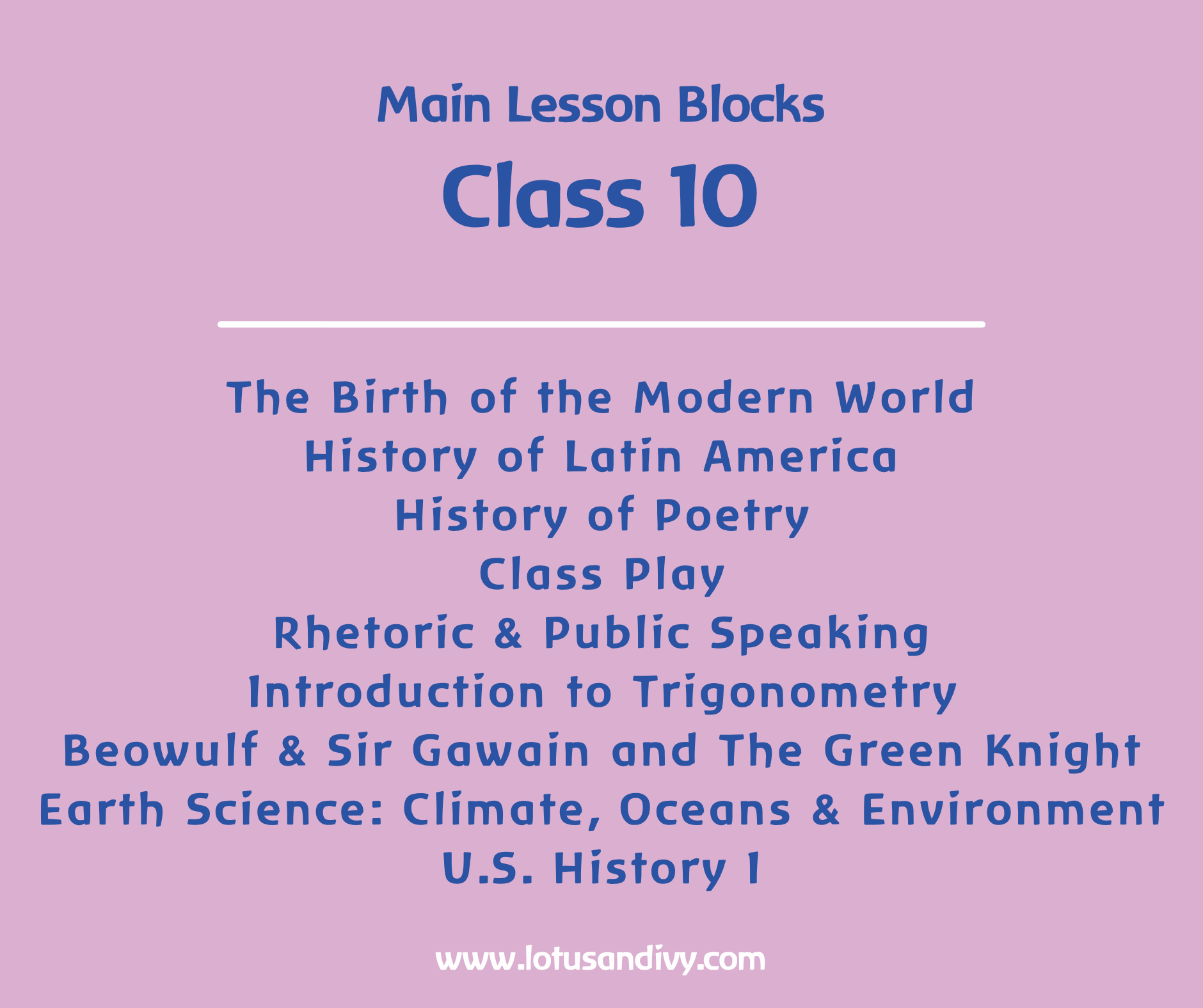
*Order of blocks is subject to change. Please refer to the Block Schedule for updated information.
Balance and harmony is another overarching theme of the 10th Grade curriculum. The 10th Grader’s thinking is no longer restricted to black and white, but they can now perceive from multiple viewpoints, further allowing them to look at tensions between opposites and the work it takes to find harmony. This harmonizing of opposites to find a new balance is a profound new skill. The 10th Grader is transforming and experiencing many changes internally, and the nourishment of finding balance and harmony supports them in the changes they face in their transformation to adulthood.
Just like in years past, the Waldorf curriculum mirrors for the student examples, through stories or real-world situations, where transformation was reached successfully. This helps call forth the courage within the student to transform.
Birth of the Modern World
The Birth of the Modern World is a four-week 10 th -grade history course exploring how the world we live in today came into being. Through the study of the Middle Ages, the Renaissance, the Age of Exploration, the Reformation, the Scientific Revolution, and the great political revolutions of themodern era, students trace the long transformation from traditional societies shaped by hierarchy and inherited authority to a world increasingly defined by individuality, global exchange, scientific inquiry, citizenship, and human rights. The goal of this block is not only to understand what happened, but to ask why these changes mattered and how they continue to shape our lives today.
The course also attempts to examine this history through a critical lens. While Europe played a central role in the rise of many modern institutions, students will also explore the essential contributions of Africa, Asia, the Islamic world, and the Indigenous peoples of the Americas, as well as the human costs of conquest, slavery, and empire. The modern world is understood here as a global story of exchange, creativity, conflict, and transformation.
The block follows a single developmental arc, which includes:
• Week 1 - Middle Ages: Belonging and hierarchy. A world held together by faith, duty, and inherited order.
• Week 2 - Renaissance: Awakening individuality. The human being discovers themselves as a measure of all things. Age of Exploration: Expansion and encounter. The world becomes connected and permanently altered.
• Week 3 - Reformation: Conscience and authority. The individual claims the right to interpret the truth for themselves. Scientific Revolution: Observation and reason. Nature is legible, predictable, and open to investigation.
• Week 4 - Enlightenment: Rights and reason. Political and philosophical ideas converge toward human freedom. Revolutions: Ideals become governments. The modern political world is born, imperfectly, violently, and lastingly.
Introduction to Trigonometry

Early mathematicians and astronomers studied circles and triangles to better understand the world around them and to apply their knowledge in such areas as navigation, construction, and surveying land. They noticed relationships between angles and ratios of lengths. They created tables of these ratios to make their calculations of distance and angles easier.
We follow in their footsteps and use modern notation and tools to describe and prove the same relationships. Real-life applications enrich the classes with meaning and provide opportunities for students to deepen their understanding of this area of geometry.
Topics include:
Angles and their measure
Angle relationships
Similar triangles and ratios in triangles
Introduction to trigonometric functions: sine, cosine, tangent
Proof of the half-angle formula
Graphing trigonometric functions
Historical background: the work of Babylonian and Greek mathematicians
Modern-day examples of practical applications
Most classes will include hands-on activities requiring the use of a compass, a protractor, and a ruler set as we create a beautiful Main Lesson book to reflect our learning during this block.
History of Latin America
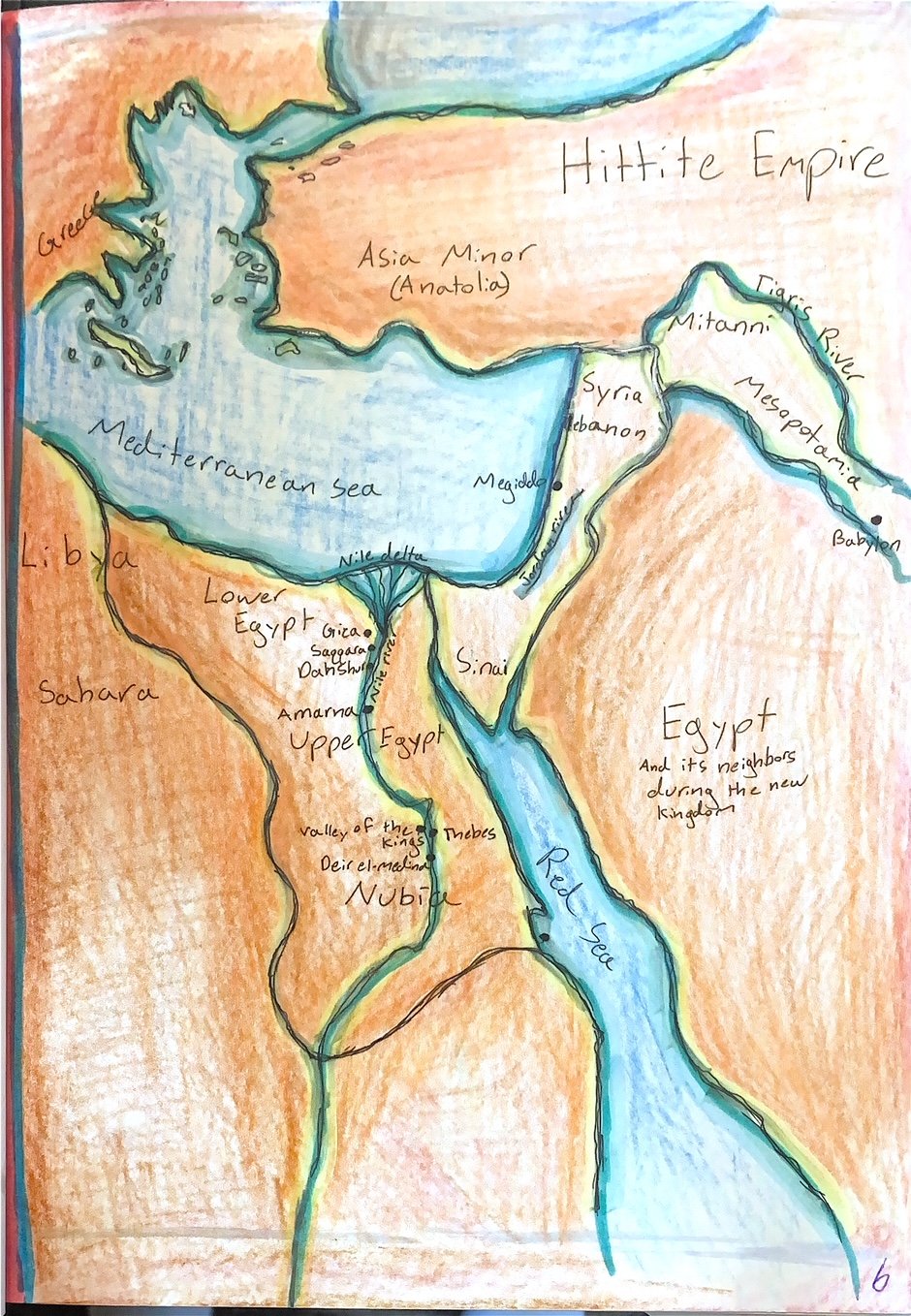
A primary concern of Class 10 students is the question of causality and origins. “How did things come to be as they are now?” is a fundamental question that young people ask of the world. During this lesson block we will be going deeply into history sweeping through the transition from hunter gatherer lifestyles to the highly structured urban civilizations and reflecting on the change in human consciousness that accompanied these transitions.
It is important for the pupils to use their own thought processes so that they have a genuine experience of the matters they've come to understand. Therefore, the lesson work and activities will evolve from each student's understanding of the subject matter, summarizing and recording the work in their own words into their lesson books. Inspiration for art projects will similarly be drawn from the themes covered in class.
The themes covered in the 1st lesson block of ancient civilizations:
· The human revolution of the upper paleolithic: Ice Age societies, culture and art, new technologies and the expansion of humans into all continents and new environments, Australasia, the Pacific islands, North and South America, Siberia, northwestern Europe.
· Ice Age art can be seen as the flowering of the highest cultural level, in a very specific context. In Ice Age art we can see not the beginnings of culture but an already advanced stage of development in which the idea of ritual, religion and the sacred place were well established.
The end of the Ice Age, rising sea levels and corresponding loss of land in many parts of the world: Mesolithic societies, diversification of cultural and economic life, with a loss of artistic quality and a return to a very primitive forms in art. The significance of the invention of the bow, which belongs in the period.
Neolithic age origins of agriculture.
From settlement to city: centralization of authority, writing bureaucracy trade and state religion.
A comparison between the Egyptian culture and the European megalithic culture
Enrichment activities for both these lesson blocks will include the production of ceramics and forming and shaping of a long bow.
Class Play
Our 10th grade students will bring the Bard's tale of Twelfth Night to life through puppetry during our Class Play Block this year. After having done a literary analysis in their Language Arts class, students will experience how Drama brings to life words on the page. In addition to voice acting the characters of the play, all students will build their own Heritage marionette with the instructor in class. These simple marionettes are very expressive and can be manipulated easily with one to two hands. Students will set up their own polished background and learn to manipulate their puppet to get the most expression out of them as possible for the production.
Rhetoric & Public Speaking
One of the greatest challenges for young people in our time is to find their footing in an increasingly noisy world. Public speaking is an essential part of this process, serving as a bridge between internal thought and external action. During this block, students build their self-confidence on a foundation of greater self-knowledge and self-awareness. By studying the art of persuasion and the power of the spoken word, students learn to stand grounded, speak with intention, and share their unique voices with clarity and conviction.
Topics include:
The history of Rhetoric
The Three Pillars of Persuasion: Ethos, Pathos, and Logos
Vocal presence, breathwork, and the physics of speech
Crafting a narrative: the architecture of a great speech
Overcoming stage fright through mindfulness and preparation
The art of active listening and constructive critique
Final Presentation: Delivering an original "Main Lesson" speech
Beowulf & Sir Gawain and The Green Knight
In this block, students journey back to the roots of the English language by immersing ourselves in two of its oldest and most powerful epic poems. As we transition from the rugged, heroic world of the Anglo-Saxons to the chivalric mysteries of the Middle Ages, students do more than just read; they exercise their intellects and imaginations to bridge the gap between the ancient and the modern. By learning to pronounce the resonant vowels of Old English and the lyrical lilt of Middle English, students connect physically and aurally to the ancestors of their own speech. Class 10 students will explore deep, perennial themes that continue to shape the human experience today.
Topics include:
The evolution of the English language: from Old English to Middle English
The nature of courage and the "hero’s boast" in Beowulf
The quest for life’s meaning and the chivalric code in Sir Gawain and the Green Knight
The essence of love, loyalty, and temptation
Comparative analysis of epic poetry and medieval romance
Creative and reflective writing inspired by the themes of the quest
Earth Science: Climate, Oceans & Environment
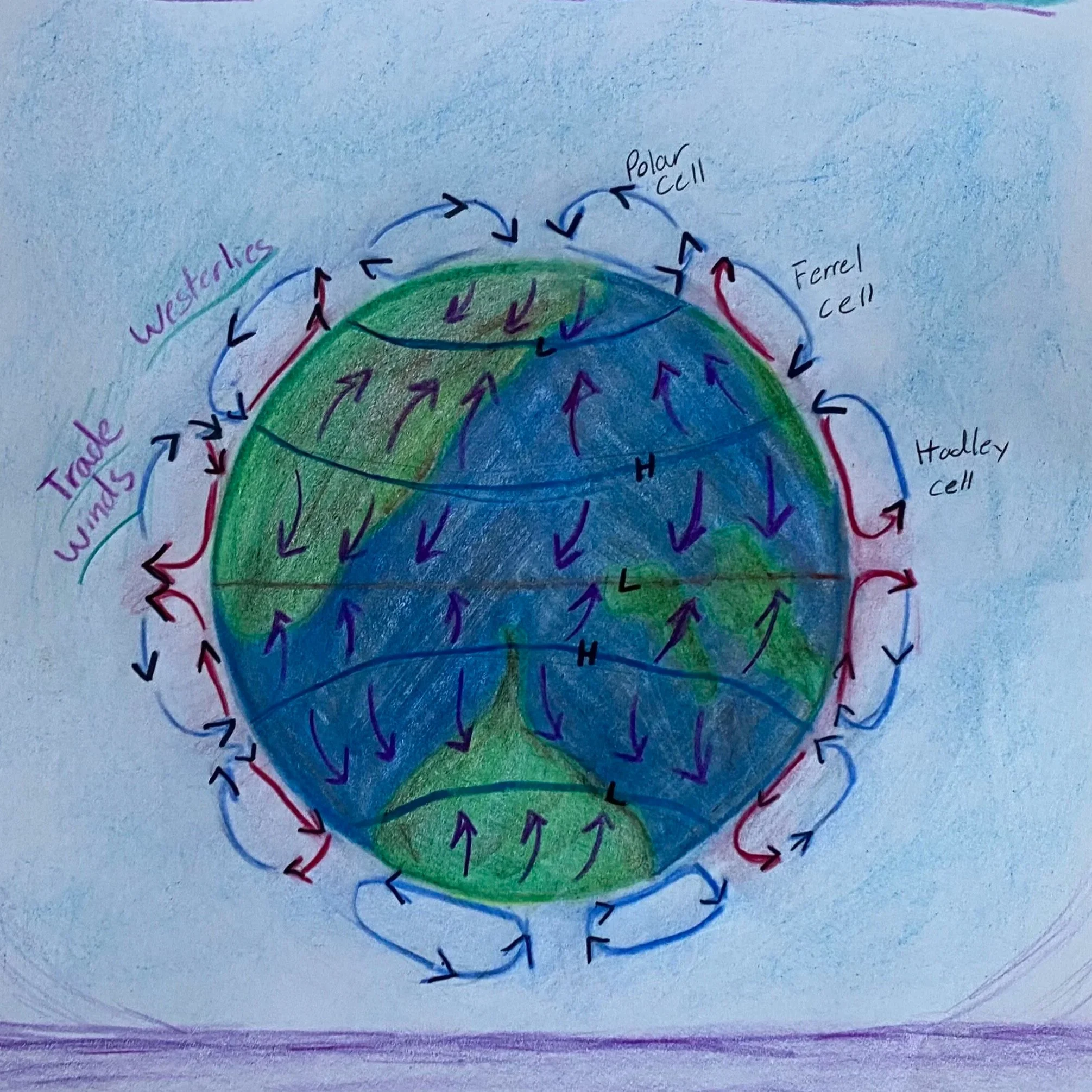
Earth science in grade 10 will cover themes related to “The Earth in Its Entirety” or “The Earth in Motion". Students will explore the "why" behind many phenomena related to climate, currents, tides, and metamorphosis on the earth, leading to the inevitable discussion around the question: Does Earth in its entirety constitute an organism or is it a dead inorganic structure? In this block, students will begin to work on this question by focusing on a variety of motions in the air, water and rock spheres of the earth [atmosphere, hydrosphere and lithosphere].
Through observations, we will work to build an understanding of the relationships between pulsating vertical motions and circulating horizontal motions. These two modes of motion will be investigated in three partitions of the earth in a differentiated yet interconnected way. When looking at the earth’s atmosphere, we will first focus first on the global circulation of winds. In doing this, the difference between winds that blow above the oceans and winds that blow above the continents will be discussed, as well as the many implications that these patterns have on everyday life.
In the discussion of areas of high and low pressure, we will deal with the second mode of motion: staunching and loosening. The understanding of the largescale processes of the weather arises from the penetration of both modes of motion. Then, we will discuss the structure of ocean currents and the tides which exemplify these different motions in the hydrosphere. Lastly, we will tie these themes together by looking back at our work done in ninth grade with respect to the motion of the lithosphere.
History of Poetry
In this Main Lesson block, students explore the evolution of poetry and its distinct relationship to prose. The journey begins with the familiar—sharing favorite song lyrics—before looking back at ancient texts to discover the threads that connect them to the modern world.
Students are introduced to a vast range of poetic styles, investigating everything from Ancient Greek choruses and Anglo-Saxon alliterative verse to the heroic couplets of the classics. By analyzing how words create mood and the distinction between vowel and consonant-rich pieces, pupils master the essential aspects of rhythm, rhyme, and metrical form.
The block emphasizes the living nature of the spoken word. Students study the biographies of great poets while simultaneously writing and performing their own spoken word poems and raps. This creative process culminates in a published anthology of pupil writing and a live presentation for grown-ups at the end of the block.
US History
In this block we will examine the ideals of equality, freedom, justice, and peace that have inspired the creation of self-government in the modern age in the United States. Emphasis will be placed on studying how the U.S. government functions today, and how it both developed and evolved in the 18th and 19th centuries. The story of the United States will be woven together through the lens of human rights and revolutions. Students will work on understanding the history of the United States by analyzing the foundational documents, interpreting political posters, and listening to folk and protest music which encapsulates the sentiment of the American people during pivotal times. In their work, students will practice the discernment of information from multiple sources, and learn how to identify media bias and propaganda. Particular emphasis will be placed on the Constitution, the government it created, and the rights and responsibilities it upholds for the citizens. This class will expand upon themes that were introduced in the Grade 8/9 US History course, but it will not be a repetition of that same content.
High School Faculty
Lotus & Ivy teachers give utmost thought and care in planning lessons to encourage the highest mental, physical, and social-emotional engagement for our students. As with our lower grades, our high school experiential lessons are live and interactive, and our students are part of a nourishing community of peers and teachers. To read the biographies of our High School Faculty, please visit the Teacher Page.